Wednesday, 4 November 2009

Northern Lights

I drove up to Yorkshire a week ago for the last night of 'Odin's Glow', a public art event set in the village of Newton-Under-Roseberry.


The event comprised illuminations of Roseberry Topping, the mountain that overlooks the village, together with a number of installations and performances in the streets and spaces below, pedestrianised for the four nights of the show. 


The event celebrated the Viking heritage of the area - Roseberry Topping is an anglisation of the Norse for Odin's Rock. So lots of runes and audio re-telling of Norse myths.  In an odd bit of artistic direction, the event also covered the life of Caption Cook, who once lived there too.  This made the evening feel a bit schizophrenic for me - the themes didn't really come together very well, and in my view a flawed compromise had been made somewhere in the planning process.


However, it was great to walk through a rural village at night, transformed with light and sound, and the sense of occasion was palpable, even if some of the installations were a little underwhelming.

The star of the show was unquestionably the mountain of Roseberry Topping itself, dramatically illuminated by Filament, and stopping crowds at every spot in the village from which it was visible.  An unforgettable sight. 


Most photos from http://www.flickr.com/photos/blue-don/ - many thanks.


Sunday, 4 October 2009

Bothy in the Black Mountains

By the time I'd parked up at Gospel Pass and climbed onto Twmpa, the sun was setting and the colours were seeping out of the landscape.  By the time I reached the head of the reservoir at Grwyne Fawr, I was relying on the moonlight and my headtorch to find the bothy that I knew was there somewhere ...

Every outing has its lessons:  earlier this year I'd learned that if night is falling and you can see that your torch is running out of power, it's better to change the batteries before they completely run out in the middle of a dark wood. That kept me busy for a while. 

This time, the lesson was that if you're heading to a bothy you've never visited before and arriving in the dark, it's a good idea to write down the grid reference rather than just memorise it.  The dark plays havoc with your convictions:  was it 227312 or 222713?  Of course there was no mobile signal for me to call home and check.

After a brief but entertaining game of hide-and-seek, the bothy finally gave up its location at the bottom of a steep gorge where the stream flows into the dammed valley. It was fairly invisible from the path. 


I love the moment when you push on the door of a bothy and let yourself into a stranger's house.  Simple shelters are so luxurious when benighted in the mountains.  This one was cute as a button:  one small room with a sleeping platform upstairs, across the stream from a small copse of trees providing fuel for the woodburning stove. The previous occupants had done me proud, leaving new candles, dry wood, a whole bag of kindling, all of Saturday's paper and half a bottle of Sambucca!

With the stove roaring, dinner on and the candles flickering, I put my sense of euphoria down to the night walk, the stunning location and perhaps partly the Sambucca.  I kept having to go back outdoors to admire the fat silver moon gleaming over the reservoir and the bulk of the Black Mountains.


In the morning I gathered some dead wood to replace what I'd used and spent a bit of time sawing it into logs for the next visitors.  Karmic equilibirum established, I headed back up the valley and onto the long ridge of Waun Fach, the highest point in this Eastern section of the Brecon Beacons National Park.  It was fun watching the gliders for a while, until I climbed into cloud and spent the next couple of hours following compass bearings in the fog.  I bet the views are great!


I came back down into the visible world alongside the thick pine plantation of Mynyyd Du Forest, where I found a flat section alongside the river adorned with a succession of fire rings, at the end of the twisting road coming up from the South.  It's amazing how well roads deliver litter into the landscape:  I was a bit saddened by the plastic bottles, and bemused by the quantity of loo roll strewn around the woods:  the lack of poo suggests that girls are to blame.  Girls - drip dry or burn your loo roll!


I rigged up my tarp and gathered kindling and fuel as the evening swept in.  Two other groups of campers drove in and joined me in ignoring the 'no camping' signs.  Actually, it was one of those pictorial signs with a line through a tent, so I felt OK about my tarp.  Perhaps the Forestry Commission should try education rather than prohibition, which clearly doesn't work.

I woke up warm and rested at dawn, and seized the day, breaking camp around 8am.  As I climbed the opposite side of the valley to that explored the day before, the weather turned pretty nasty and I shortened my route back to the car.  It was still three and a half hours of battling the wind and the sideways rain, but all good fun and I've seen worse.  At least the ridge was broad enough to make falling off impossible.  It's amazing how far your snot can fly in a mountain wind ... I wonder whether there's a record for that?

The bothy at Grwyne Fawr is maintained by the Mountain Bothies Association: you can subscribe for £20 at http://www.mountainbothies.org.uk/

Thursday, 24 September 2009

Schools Without Walls

I often say to people that education is full of assumptions that we forget to challenge. The system of universal schooling in the West is relatively young, and yet we cling to many of its orthodoxies as if they are ancient traditions.

Picture a school. Do you see a building?

Schools can't bear the whole burden of reconnecting our children with the natural world, but they can certainly do their bit. The Forest Schools initiative is one the best vehicles we have for helping schools to move lessons outdoors: it is systematic, sustainable and easily understood.

After a period of accredited training that can be fitted around their existing job, a teacher takes pupils out into a local woodland for half a day every week or fortnight. There's huge diversity in the practice, but commonly the subjects of the 'normal' curriculum are taught through the use of natural resources, and there is an emphasis on social and emotional development. Over time, pupils learn to use tools, to control fire and to manage their environment responsibly.

Surprise surprise, children who spend regular time outdoors find it easier to concentrate, show fewer symptoms of ADHD, develop better social skills, improve their creativity and outperform their indoor peers in academic achievement.

Research in the US has led to calls for a daily 'green hour' for children, as a pre-condition for effective learning. It's a start, and I sense that a more fundamental change is coming.

http://en.wikipedia.org/wiki/Forest_Schools

www.forestschools.com

http://www.childrenandnature.org/

www.greenhour.org


Thursday, 3 September 2009

In Search of Stone

One of my favourite artists is the sculptor Peter Randall-Page. Based in Devon, just East of Dartmoor, Peter works mostly in stone, making art works that explore and reflect the patterns, geometry and mathematic relationships found in biology.


There's an etymological relationship between art, artifice and the artificial, but my interest is the opposite: I see art as a natural aspect of our behaviour as a species, just as other animals have their inevitable forms of culture. What I enjoy most about Peter's work is how alive and organic it feels. Somehow he intersects animal, vegetable and mineral, to make sculptures that look like a living part of the landscape.


I loved Peter's sculptures at the Eden Project and Yorkshire Sculpture Park, and wanted to see more. After the pristine finish of the Eden commission, I was irrationally shocked to find his pieces in the Forest of Dean being colonised by mosses when I visited in 2008. Of course outdoor sculpture has to weather naturally, and the ageing of work is often intended by its maker, but initially I struggled with the contrast in presentation.


A year later and a year further on in my own outdoor arts career, I couldn't miss Peter's major exhibition at the Yorkshire Sculpture Park (closes January 2010) and headed up the M1 earlier this summer.


It was fantastic to see so much of his work, but strangely unsatisfying to see it all in one place.

I guess I'd got used to the idea of searching for Peter's stones: making special journeys and enjoying the sense of discovery and the relationship between the work and its location. For me, Peter's work needed to occupy a more fertile space than it was given at YSP. And the continuous reminders of the 'no touching' rule hardly invited personal connection to the art. Of course I snuck a few touches while the stewards weren't looking: just to look is to miss half the point of sculpture.


The YSP experience reminded me how important environment is to my enjoyment of art, and made me want to re-experience Peter's work in a wilder context. The artist Jenny Kyle lives near Peter, and had told me before about a series of his sculptures installed around the Teign Valley in the early 90s by Common Ground. I got hold of a beautiful book about the project, 'Granite Song', with photos by Chris Chapman and some interesting essays. I learned that granite contains no fossils because it predates life on earth.

Armed with grid references and a few spare hours when passing through Devon this week, I set out to try to experience some more of Peter's art in a wilder and less formal context.


This piece, 'Passage', stands perfectly atop an avenue of old Beech trees across the valley from Castle Drogo, reached by an unmarked permissive path up the hill from the River Teign. The weathering of the stone has created the illusion of the lead inlay standing proud of the cut faces of the boulders. It appears to have stood there forever.

On an island in the River Teign downstream of Chagford sits 'Granite Song' itself, the first of the iconic split boulder forms that have become such a motif in Peter's work. It's exquisite - and in quiet counterpoint to its setting of woodland and rushing water. You'd miss it from the footpath if you weren't looking for it.


Perhaps it's special to me on its own account - it's pretty gorgeously curvy and pointy, and on a more intimate scale than many of the pieces carved after it. Or perhaps it's because I waded across a river and beheld it with all my senses that the joy of it still rings in my ears.


Tuesday, 25 August 2009

Happy Birthday Outdoor Culture

OK, so in fact Outdoor Culture has been trading for 17 months now, but the exciting news is that yesterday I heard from the regulator that our application to become a CIC (Community Interest Company) has been approved. Yay!

This means that Outdoor Culture is now officially a not-for-profit social enterprise - a status that properly reflects my aim to highlight the links between the health of our children, our environment and our society, and to forge fresh and meaningful connections between the arts, education and ecology sectors.

In practical terms, this is something of a rebirth for the company, as it confers extra credibility when meeting new partners and greater autonomy to access funding streams with less reliance on the charitable partners we work with. Outdoor Culture CIC can be bolder and more daring that its predecessor.

The mission remains the same: to create imaginative experiences beyond buildings, that explore human wildness and reflect our natural heritage.

I still can't quite call myself a social entrepreneur without wincing, though. It's a bit worthy and earnest, and wrongfully implies that I know something about business. I may stick with the arts label of creative producer for now ... unless social entrepreneurs get cheaper insurance?

Wednesday, 15 July 2009

Playing with Fire

Of course fire is dangerous. It's an elemental force. 'Don't play with matches', we tell children. 'Don't light fires' say the landowners to the public.


And yet the use of fire is the clearest, and perhaps earliest element of human culture that distinguishes our learned behaviour from that of other animals. It is ubiquitous, from the internal combustion engines that power our cars to the proposed 'biochar' technology of the future.

Our control of fire may even have fast-tracked the evolution of the rest of our culture: an evening fire providing warmth and focus for conversation, music and ritual after the day's work. And we remain fascinated by the flicker and glow of real flames.

The paradox is that beyond our own property, it is now hard to find places where open fires are allowed. This fuels a vicious circle: without opportunities to make fire in the public landscape, we lose our ability to do so, and it becomes yet more risky to allow fires to take place.

I would argue for the need to reclaim this quintessentially human activity. By playing with fire, we learn how to control it, and it connects us with the elements of our world - fuel, air, heat, light and cabon.
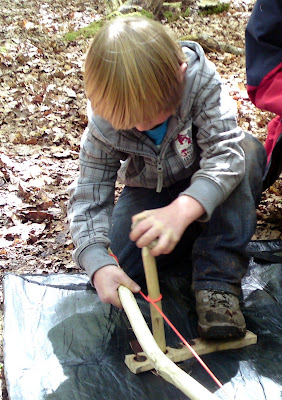
Children will always want to start fires: why not teach them how to do it safely? On the family bushcraft course I co-created with Andy Noble www.naturescraft.co.uk , children as young as 5 learn about selecting fuel and kindling, fire-starting by spark and friction, and campfire husbandry.


I'm very much a beginner in bushcraft, but I regularly make and enjoy fires when wild camping below the tree-line. A well-managed fire poses no real danger, and enables us to stay outdoors longer, enjoy the night and connect more deeply with wild places. People will only value what they know and love. It's time that our national park authorities and other stewards of the natural landscape took a longer view of this issue, with a policy to tolerate responsible use of camp-fires coupled with a drive for better public fire-literacy.

This is my personal practice:

1. Use a firesteel - it's an alloy rod that produces hot sparks when struck with a steel striker or knife. Easy to use, never runs out unexpectedly and works in the rain.

2. Carry dry tinder - bushcrafters may sneer but cottonwool is cheap, light and effective.

3. Take a folding saw, and use it to trim timber to size. No point burning more than you need.

4. Find an existing fire ring or pit close to running water, which you need anyway if you're camping. Have a container for dousing close to hand. If you can't find an existing fire ring to camp by, you can cut an area of turf that you can replace the next morning.

5. Locate the landowner and secure permission for your fire (could be tricky!)

6. Gather yourself some bundles of progressively thicker twigs. You're looking for twigs about 12 inches long, initially the thickness of a match, ending up with logs as thick as your arm - a small fire won't need anything bigger. Gather dead wood from live trees (no leaves or buds on what you remove) or from the ground, but only if standing on end or resting on other timber: sticks lying down absorb misture from the ground. This will take about 45 minutes.

7. Ignite your tinder on a small twig platform and lay the bundle of thinnest twigs on top, followed rapidly by two bundles of slightly thicker twigs, etc etc until established.

8. Get dinner on the go.

9. Crack a beer and watch the stars come out.

10. In the morning, scatter any unburnt wood and replace any cut turf so as to leave no trace of your fire. If you cut more wood than you used, hide it out of sight for next time ...


Andy Noble's next family bushcraft course is on 19 and 20 September 2009. For info on this and other course, visit http://www.naturescraft.co.uk/ Mention Outdoor Culture and you get a discount ...

Monday, 15 June 2009

Fun in the Sun

A few pics here from a recent 2-day trip to Ennerdale, in the North West of the Lakes.

I'd been told that Ennerdale was the most beautiful valley in the Lakes.

Not your average Lakeland weather.

Climbing the ridge up beyond the tree line.


Ennerdale Water, from near the summit of Haycock - the hills of Galloway just visible across the sea.


Me on the summit of Steeple, with Great Gable on the left horizon.


Shadows descending to the valley floor.


Home sweet home down in the forest.


I couldn't resist a morning dip in the lake. It felt fantastic.


A special trip to a special place.