Saturday, 24 January 2009

Walkers Bikers Paddlers

Snowdonia was fun.

I got to the forest of Coed Y Brenin on Friday evening, and impressed myself by locating the dark bothy in the dark woods a mile or so from the road. A bothy, if you didn't know, is a basic uninhabited house, usually in a remote area, maintained for overnight use by anyone who can find it. If you join the Mountain Bothies Association, you get the grid references for loads of them, mostly in Scotland but with a few in Wales and Northern England.


The bothy at Penrhos Isaf was empty on my arrival, and I had the place to myself on Friday night. With candles lit around the house and a fire going in the stove, I felt at home pretty swiftly. After dinner and a beer, I retired to my sleeping bag and roll matt on the wooden floor upstairs. The people who joined me the next night were surprised that I'd had the nerve to spend the night there alone - but then at that point I hadn't heard of the ghost ...

In the morning I had a bit of an explore around the forest, which I think I also had to myself, and drove South to the foot of Cadair Idris, the Giant's Armchair. I'd wanted to climb this mountain for ages and the weather was fine if a little windy.


The Minffordd Path winds its way around into Cwm Cau, before climbing the ridge that leads up above Llyn Cau. I never actually made it to Pen y Gadair, the very top of Cadair Idris, but turned back at the top of Craig Cwm Amarch (summit pictured) in what had become a ferocious gale. Still, I had a good look around and I'll definitely be back.

I headed back to the bothy to find two vets, a steel-worker and a website designer esconced by the fire. A lot of the conversation, naturally, revolved around outdoor activities. My house-mates for the night were into mountain biking and kayaking: apparently both are about tapping into elemental forces to carve your route - like drawing with gravity. When two more guests arrived later that night, they opened a conversation with the question 'Walkers? Bikers? Paddlers?' Perhaps there are only three kinds of people.


I took advice from one of the guys who professed to be all of the above and headed out to the Rhinogs on Sunday under blue skies and cold air. Rhinog Fawr from the East looked much more impressive in reality than it did on the map, and I enjoyed the wild feel of the place on the walk-in through forest and then up what started out as pathless, boggy mountainside. I eventually found an unmapped track that sped up my progress to the summit, where I got pelted by sideways hail and more ridiculous winds.


I only saw two other people on the mountain all day. I spotted some wild mountain goats out on the hillside - apparently they're descended form domestic animals but now totally feral. I thought this moss was every bit as wild, and easier to photograph.

Wednesday, 14 January 2009

Small Wonder

January's shaped up into a busy month for me, and the longer I spend at my computer, the easier it is to forget that one of the reasons I started Outdoor Culture was to spend more time outdoors myself. Most months I get away to the mountains, and this weekend I'm off to Snowdonia to have a look at Cadair Idris and stay at the bothy at Penrhos Isaf. It'll be my first time in a bothy, so no doubt I'll have something to say about it on this blog in due course.

I haven't been away since January, but the Chiltern Hills have been really doing their stuff recently, and I've made a point of getting out for walks with and without my children.

I'm a fan of artist James Aldridge's blog, with its reminders of the small wonders all around us, and thought I'd post up a few photos and thoughts inspired by James' way of thinking and the beautiful countryside just beyond my front door.

I took these photos on 11 January, after a brief flurry of snow had melted, and a freezing fog laid amazing ice crystals all over the Chilterns.


I went out for about four hours, covering a fair distance from Great Missenden through Little Hampden and across the valley to Great Hampden and home again through the woods in the dark. The fog and the frost made everything unreal; unfamiliar. The absence of grand views made it easier to read the small print in the landscape.


I pushed the ice off these buds with gloved fingertips. Spring is at the heart of winter.


Avian signposts - pointing away from the direction of travel. Look where I've been: this is where I come from.

Tuesday, 2 December 2008

Deck the Halls


My poor children. Life must be very confusing for them.


They come home from their nativity rehearsals thinking they’ve got Christmas straight in their heads, and then I start banging on about Yule logs, festivals of light and the earth’s orbit.


Our modern culture of Christmas is a mix and match affair that brings together a number of belief systems. The Christian story of a new hope for humanity chimes perfectly with the ethos of the mid-winter festival that it replaced in early Christian Rome: Dies Natalis Solis Invicti, "the birthday of the unconquered sun.", was celebrated in Rome on 25 December, after the night of the winter solstice, to mark the beginning of the lengthening of the days. The candles, gift-giving and merriment had already been appropriated from the Saturnalia festival that originally concluded on 23 December.


Many aspects of Christmas come from Northern Europe, where late convertors to Christianity were encouraged to recast their cultural traditions in a new spiritual light. Yule is thought to derive from the Old Norse word for wheel, again marking the turn of the winter and the inevitable rebirth of the sun. The Finnish Joulupukki is a character who dresses in warm red clothing and goes from house to house bringing gifts for well-behaved children – sound familiar?


Christmas for me is a celebration of light in the darkest time of the year, a chance to express goodwill to others through the giving and receiving of gifts and a space to reflect and commune with my family. But my favourite bit of symbolism is our bringing of the outdoors indoors, with fruit-bearing holly and mistletoe and of course, a decorated and illuminated evergreen tree, to mark the miracle of life and and our place within it.


Winter festivals were always big news for agricultural societies, coming at a time when there was less work to do and long dark nights to fill with drinking and dancing. If there’s anything I regret about the evolution of Christmas, it’s the way we’ve replaced dancing with slobbing out in front of the TV.


Still, there’s always New Year’s Eve ...

Tuesday, 4 November 2008

Wild Child

I was in Wasdale in the Lake District when the Original Mountain Marathon was suspended amid severe weather. Paths became rivers, streams became impassable torrents and the athletes struggled to stay upright in the wind. At nightfall, an unknown number of runners were unaccounted for, sparking a level of media interest that stunned the race organisers, who had proceeded with the event against the advice of local mountain rescue teams.

I’d seen the weather forecast, which was quite good for the following days, and decided to drive up to the Lakes through the bad weather in order to be there already when the rain eased off and bag myself a few days’ walking. I managed to drive through almost the whole length of the flooded lane that flanks Wastwater, before abandoning my car and wading the last half a mile to the Wasdale Head Inn.

In the morning, one section that I had driven through looked like this:


It’s not every day that you get to drive through the deepest lake in England in an MX5.


Whatever you think of the race organisers’ decision-making, it is inevitable and healthy that people take risks in the outdoors. High on Yewbarrow and Red Pike the day after my arrival in Wasdale, the wind was still wild enough to offer a challenge and to blow in a few hailstorms quicker than I could get my raincoat on. Beauty, scale and the landscape’s timeless indifference to humanity will always be part of the thrill of the mountain wilderness, and its importance to our wellbeing.


A few days later I took a walk through a local wood in Buckinghamshire, surprising a muntjac deer, a hare and an owl. The autumn colours glowed into the dusk. That night, the clouds dumped an inch of snow on the Chiltern Hills, bringing down several beech trees whose leaves couldn’t shed the weight. I was reminded of Robert Macfarlane’s evolving sense of wilderness in his fabulous book, The Wild Places. From an initial view of wilderness as remote and extreme, he comes to see ‘the wildness of natural life ... the weed thrusting through a crack in a pavement, the tree root impudently cracking a carapace of tarmac’ and is forced to re-appraise the wild qualities of his own local landscape. I wondered why I’d burned carbon all the way to Cumbria when there is wilderness on my doorstep.


The importance of accessible, local, green space to communities in the UK can’t be overstated. The big national parks are important, but not more so than the woods down the road. This month’s Trail magazine quotes at length from Richard Louv, an inspiring US campaigner for a child’s right to experience the gifts of nature. Check out
www.lastchildinthewoods.com . Louv coined the term nature deficit disorder to describe the net results of urban sprawl, reduced play range, increased safety fears and the growth of indoor, sedentary culture for children. In medical terms, it looks like ADHD, childhood depression and obesity. In social terms, it looks like dislocation, disaffection and rootlessness. The health of our children, our society and our environment are all linked.

Children learn to take risks in natural spaces. They learn to wonder. They value what they know. Without action to reverse the trend, my generation will have been the last in the UK to splash unsupervised in streams and climb trees en masse in the woods. Without immersive experiences in nature, environmental education is a joke. Louv and others have articulated the problem: the UK’s schools, parents and agencies must act. I think this will become the issue of our time.

I’m not prepared to be the last wild child in England.

Return to Teignhead

Flushed with the success of the Millie procession (see previous post), I picked up Bex and we bombed down the M4 towards Devon and the magic of Dartmoor. As far as the traffic jam, where we sat for the next hour and a half.

The plan was simple: a night of indoor luxury at Bristol’s Hotel Du Vin, followed by a night of outdoor luxury, wild camping at the remote ruins of Teignhead Farm, before heading home to be reunited with our children on Sunday night. It was going to be one of those weekends where everything takes longer than planned and everything happens a few hours behind schedule. We had a great time at the hotel, sitting down for dinner at 10.45pm, and not checking out until about midday. Great shower!

In welcome contrast to my previous trip to Teignhead (see Get off the moor, July posting), the weather was fine and settled as we struck out North from Postbridge. I tried not to fret about getting sunburned – call me paranoid, but I got well burned on Dartmoor at Easter in 2007. The following Easter I got snowed and hailed on in sub-zero temperatures. Dartmoor’s like that. One minute you’re adrift in fog, bog and snow; the next minute it’s all sunshine and ponies.


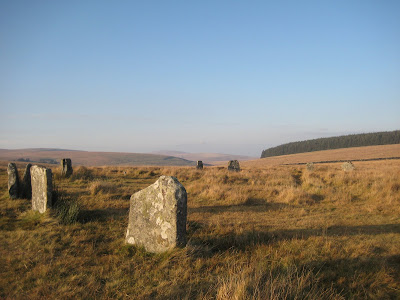
We made it to Grey Wethers stone circle in fairly good shape, and admired the open views over the moor. What happened to the communities that built all these circles so long ago? Dartmoor can’t have been any easier to live on then than it is now, so what started the exodus?


We came over the hill and down to the Teign River, having an unfounded stress about other campers nabbing our pitch, and set up next to the fire ring on the edge of the farmstead by Manga Brook. It’s such a beautiful spot.

With the sun dropping and the sky deepening, we sauntered back to the woods with a knife, a saw and an empty rucksack to gather some fuel. It was twilight by the time we returned to camp with enough kindling and logs for the night. I don’t know how legal this is, but for me it fits with the Forestry Commission’s mission statement of meeting the nation’s needs ...

After a moonlit night of food and wine by the fire, we crashed in the tent and awoke the next day later than expected. We struck camp and climbed up to Watern Tor, looping back around Sittaford Tor and back to the car. The time pressure of picking up children brought a little stress around the middle of the day (why I am still so rubbish at calculating route times?) and I ended up forfeiting the pint of Otter I’d planned for the Warren House Inn, but otherwise it was mostly sunshine and ponies.

I’m so used to going to the mountains on my own, it was great to have my wife with me on this trip, and to share a bit of Bex and Al time in the great outdoors.

Wednesday, 15 October 2008

Halcyon Days

On Friday 10 October 2008, a procession of over a hundred children and local residents made its way through the Haymill Valley nature reserve in Slough, in the culmination of Outdoor Culture's first public art project. The two children leading the parade wore cloaks of felt kingfisher feathers - every child had made one - as a gesture to welcome the Millie Kingfishers.


We were blessed with a perfect, bright autumn afternoon. The children were resplendent in kingfisher feather headresses, and the happy noise of drumming filled the woods as we strolled along the ancient mill stream. Along the way, we passed this installation of copper kingfisher amulets - every child had made one - spinning and glinting in the dappled sunlight.


Eventually we arrived at the weir at the far end of the Millie, where one day a bridge over the stream will complete a circular walk back through the other side of the wood. Here, the two leading children removed the cloaks they were wearing and we placed them over the wings of Pippa North's brilliant steel sculpture.


The Greek myth of Halcyon Days tells the story of two lovers, one drowned and the other so torn by grief that she took her own life. The gods pitied them and transformed them into kingfishers, granting them the Halcyon Days of peace and calm in which to raise their young.

Now the Millie has a new pair of kingfishers to watch over it. I hope that some of the children who celebrated with us will love this special place and look after it too. The project has given them a personal connection with the site and its wildlife: time will tell whether or not the seeds of stewardship take root and grow.


Thursday, 2 October 2008

Pigeon stew and cramp balls

I've just returned from a bushcraft course that I set up with my friend Andy Noble of Nature's Craft http://www.naturescraft.co.uk that turned out to be one of those special weekends that only come along every now and then.


Andy's the expert, I just brokered the experience for an interesting mix of artists and environmentalists, and did my best to make sure that everyone had a good time. The latter turned out to be a pretty easy job - the group got on famously, and Andy and his brother Paul kept everyone happily busy with lots of entertaining bushcrafty challenges.

Over 2 nights and 2 days, we lit fire by friction (well, some of us did), made debris shelters, learned how to use our knifes (proudly worn by all), made string from nettles, carved spoons, butchered a pigeon each (nearly all of us, including one vegan) and slept out in the woods in our tents, under tarps or in the debris shelters we'd built. Probably my last sleep-out of the year without a tent.

I did my culture bit on Saturday night by playing a few songs round the campfire, before the baton passed to the multi-talented and very funny Duncan McAfee for some poetry and more music, until eventually we all ran out of tunes and alcohol. Paul Noble said it was the best night out on a camp he'd had in ages.

On Sunday, a few people found cramp balls growing on dead wood - also known as king alfred cakes, these black fungi are wicked for fire-lighting. Once dried, they catch easily and burn slowly, so they're good as coal extenders, transferring fire from tinder to kindling. They smell divine when they burn, but why are they called cramp balls? Puts you off eating them - like death caps, I wonder whether there's a clue in the name.

Preparing the pigeon was easier than I expected as a squeamish veggie. Less slimy than the trout I dealt with last time I was in these woods (see July's post), my bird was fluffy and heavier in the hands than I thought it would be. A small incision under the breast bone and the skin and feathers just peel away, leaving the breast eaily cut out with hardly a drop of blood. Rosy got well into it - she was looking for the girl-guide within but I think she found a full-on cavewoman instead.

For some reason I don't mind eating animals I've cut up myself, and I seem to have developed a meat habit when bushcrafting. My wife thinks I'm weird. Maybe it's like this bloke I know who only smokes in pub gardens. I tried a drag on a cigarette the other day, after not smoking for 7 years, out of curiosity. It was awful - really obviously poisonous. Bushcraft is much more addictive.

Climbing into a real bed on Sunday night felt a bit odd - other people on the course said the same thing. Houses really over-do the shelter thing most of the time. Back in the woods, I was cosy and warm and at home on the forest floor. Does this imply a fickleness in our sense of home, or a timelessness?